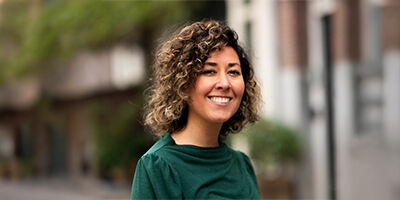
Mercedes Leipoldt
Mercedes Leipoldt works at Waag Futurelab as researcher. Her expertise is on sustainable innovation and citizen science, aiming to empower local communities through the democratisation of technology while questioning the norms of today's society. With a strong belief in the impact of (social) design, Mercedes is dedicated to tackling complex societal challenges with creativity and collaboration, exploring innovative methods that transform the way we approach systemic change. Previously, Mercedes worked at the municipality of Rotterdam, where she led initiatives in citizen participation, user-centered design, and co-creation to enhance public space management.
Mercedes Leipoldt leads the development of a methodology framework ‘Beyond Citizen Science’ and a governance structure in Pillar II that will be applied in the four application areas of Pillar III. The methodology supports the Living Labs in bringing together local communities, policymakers and knowledge institutes around shared measurement plans, collaborative data-analysis and concrete action perspectives for all stakeholders. In collaboration with Pillar I, tools for air quality monitoring are co-developed based on stakeholder needs to strengthen collective capacity, jointly monitor, interpret, and inform policy decisions on air quality. Mercedes also co-leads the Industrial emissions Living Lab Hollandse Luchten in Pillar III with Zeynep Birsel, acting as a community manager to guide the public-civic collaboration.
"What matters in citizen science is that it begins with people’s lived experiences and concerns. Open technology then becomes a tool to support those questions, making space for knowledge democratisation and shared exploration, instead of pre-defined ideas of what is worth studying"